

Table of Contents
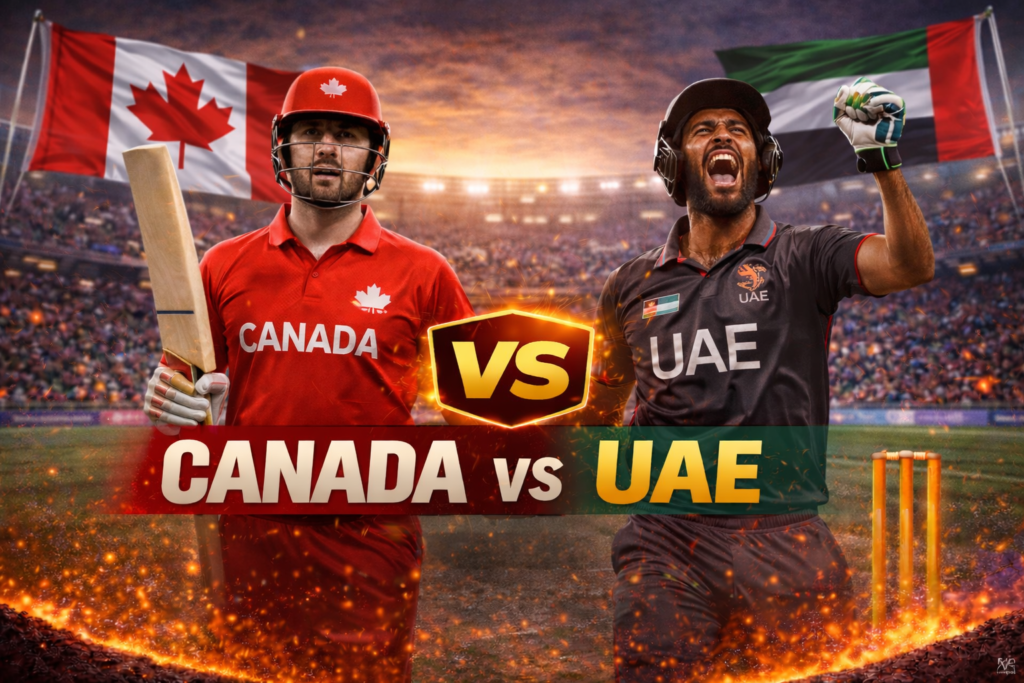
Canada vs United Arab Emirates (UAE) – T20 World Cup 2026
13 February 2026 | 3:00 PM IST
Arun Jaitley Stadium, Delhi
Group D – ICC Men’s T20 World Cup 2026
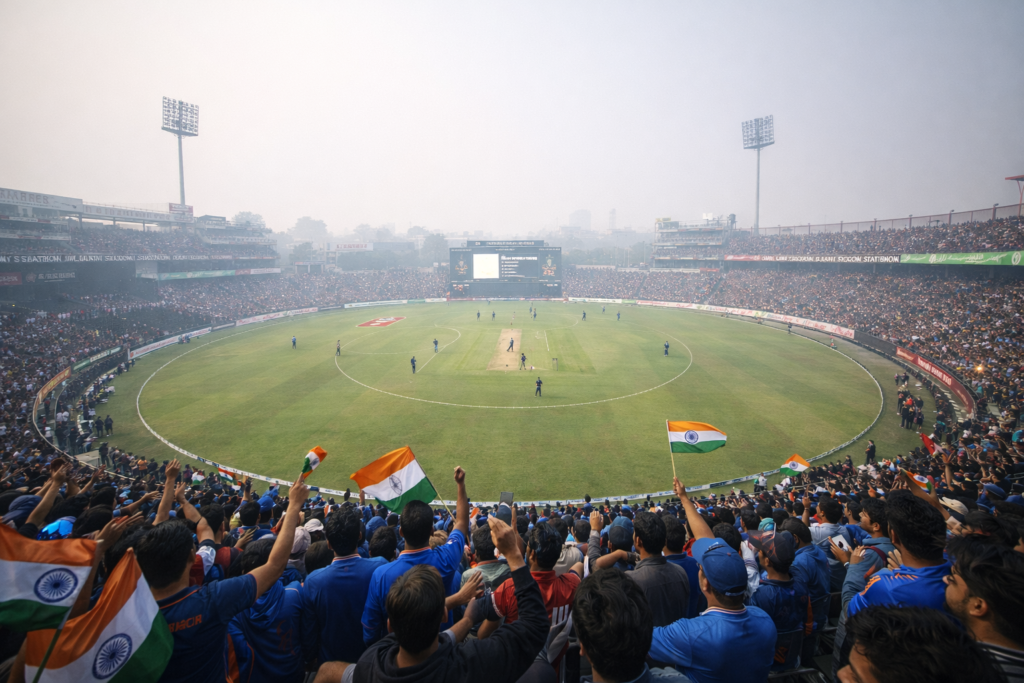
There’s a distinct energy to afternoon cricket in Delhi. The winter haze hangs gently over the stands, the crowd filters in early, and the outfield at Arun Jaitley Stadium glows under soft sunlight. It may not be a marquee India fixture, but when Canada faces the United Arab Emirates (UAE) in this Group D clash of the ICC Men’s T20 World Cup, the stakes are unmistakably high.
For both Canada and UAE, this is not just another group-stage game. It is survival.
Both sides entered the tournament as ambitious challengers from the Associate tier, determined to prove that global T20 cricket is no longer limited to traditional powerhouses. And here in Delhi — a city that has witnessed World Cup classics and IPL thrillers — they get a chance to shape their own moment.
From an India-first lens, this match is fascinating. It shows how deeply the sport has expanded. Nations outside the Big Five now compete confidently in Indian conditions. And Delhi, as host, becomes the testing ground.
Why Canada vs United Arab Emirates (UAE) Is a Crucial Group D Fixture
Group D in the 2026 T20 World Cup is competitive. With established teams aiming for Super Eight qualification, margin for error is minimal.
For Canada and UAE, this match matters because:
- A win keeps qualification hopes mathematically alive.
- A loss significantly reduces advancement chances.
- Net Run Rate (NRR) could become decisive.
In modern T20 tournaments, especially those played in India, NRR swings can be dramatic due to high scoring conditions. A 30-run defeat here can feel like two losses in the standings.
For Indian viewers tracking the bigger picture, this fixture affects potential knockout pathways and group balance.
The Delhi Factor – Pitch and Conditions Analysis
The Arun Jaitley Stadium surface traditionally offers:
- True bounce early
- Short square boundaries
- Gradual assistance to spinners
- Limited dew in afternoon fixtures
Average competitive T20 total: 165–175
The pitch typically rewards teams that:
- Rotate strike intelligently
- Avoid reckless powerplay collapses
- Preserve wickets for last six overs
Delhi is not simply about brute force. It rewards calculated aggression — something Indian teams have mastered over the years.
Canada and UAE must adapt quickly. Neither side regularly plays high-pressure matches in Indian conditions. Composure will be decisive.
Canada – Structure, Discipline, and Measured Aggression
Canada’s T20 setup has improved steadily over the last few years. Their domestic structure has strengthened, and several players have gained exposure through franchise leagues.
Key Canadian Players
Navneet Dhaliwal
Technically sound and comfortable against spin. If he anchors, Canada can build a defendable total.
Harsh Thaker
An attacking option capable of shifting momentum during middle overs.
Saad Bin Zafar
Experienced spinner who becomes especially relevant on Delhi surfaces.
Kaleem Sana
Left-arm pace adds variety, particularly useful in powerplay overs.
Canada’s key challenge is consistency. When they build partnerships, they look competitive. When early wickets fall, rebuilding becomes slow and predictable.
India-first tactical note:
Canadian batters must avoid getting trapped by spin in overs 7–14 — a phase that often determines Delhi outcomes.
United Arab Emirates – Explosive but Under Pressure
UAE’s T20 identity is aggressive. Their batting order is capable of high strike rates, but bowling consistency has fluctuated in major tournaments.
Key UAE Players
Muhammad Waseem (Captain)
Primary run-scorer and tempo-setter.
Vriitya Aravind
Wicketkeeper-batter with ability to accelerate.
Junaid Siddique
Experienced seamer, important during powerplay.
Karthik Meiyappan
Leg-spin option who could thrive on Delhi’s slightly gripping surface.
UAE’s strength lies in fearless intent. But when defending totals, they sometimes struggle to control run flow in the death overs.
India-first comparison:
UAE resembles an IPL underdog side — explosive up top, occasionally stretched in tactical depth.
Tactical Battle Areas in Canada vs United Arab Emirates (UAE)
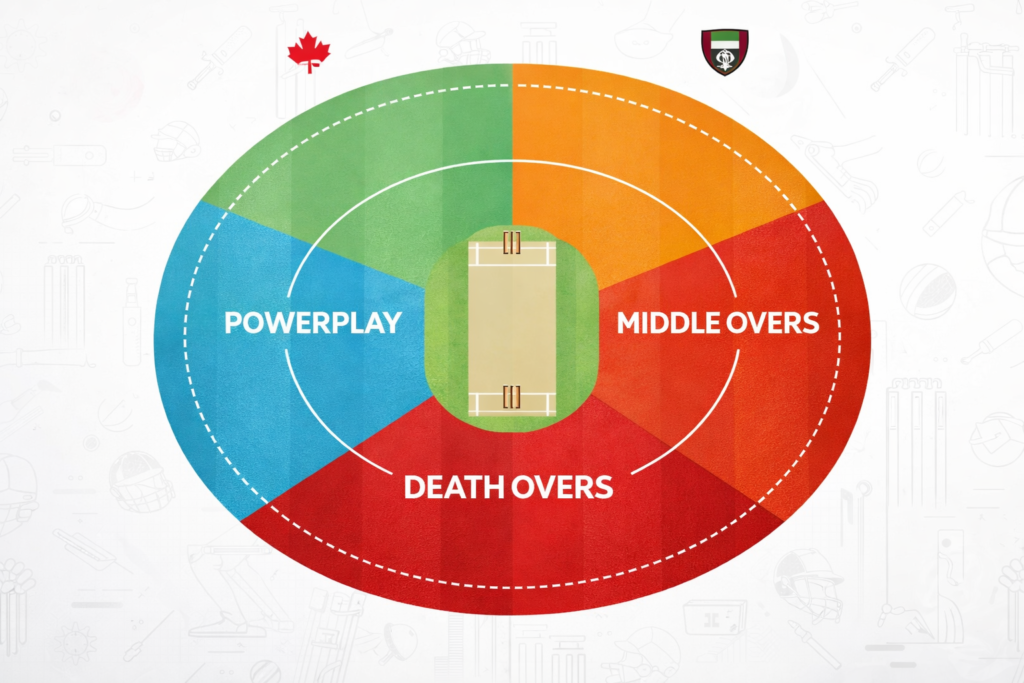
1. Powerplay Overs
Whichever team controls the first six overs likely dictates tempo.
2. Spin Management
Delhi surfaces reward quality spin. Middle overs could slow the scoring rate.
3. Death Bowling
Execution of yorkers and slower balls is critical. Associate teams often leak runs here under pressure.
Predicted Playing XIs (Based on Recent Tournament Patterns)
Canada (Probable)
Dilpreet Bajwa (c)
Navneet Dhaliwal
Harsh Thaker
Nicholas Kirton
Shreyas Movva (wk)
Saad Bin Zafar
Jaskaran Singh
Dilon Heyliger
Kaleem Sana
Ansh Patel
Yuvraj Samra
UAE (Probable)
Muhammad Waseem (c)
Vriitya Aravind (wk)
Alishan Sharafu
Basil Hameed
Asif Khan
Aryansh Sharma
Junaid Siddique
Muhammad Jawadullah
Karthik Meiyappan
Zahoor Khan
Haider Ali
Note: Official XIs confirmed at toss.
Points Table Impact – Scenario Breakdown
If Canada Wins:
- Moves to 2 points
- Keeps Super Eight possibility alive
- Improves NRR (if margin healthy)
If UAE Wins:
- Same benefit — revival of campaign
- Boost in dressing room morale
If Heavy Defeat:
- Net Run Rate damage could nearly eliminate qualification chances
In tournaments held in India, NRR swings are sharper due to batting-friendly tracks. Teams must think beyond winning — margin matters.
The Psychological Edge
This is more than cricket technique.
It’s about:
- Nerve under scoreboard pressure
- Fielding discipline
- Tactical awareness
- Handling crowd energy in Delhi
Associate nations often play fearless cricket — but high-pressure elimination games test temperament.
Final Thought
Canada vs United Arab Emirates (UAE) may not dominate global headlines, but it represents something bigger.
It reflects cricket’s expanding geography.
It highlights ambition beyond traditional powers.
And on Delhi’s historic ground, it offers two rising teams a chance to define their World Cup story.
For Indian cricket observers, this is more than a side fixture — it’s a study in global development, adaptability, and tournament mathematics.
In a T20 World Cup, survival often starts with one match.
For Canada and UAE, this is that match.
People Also Ask (FAQs)
1. When is Canada vs United Arab Emirates (UAE) scheduled?
Canada vs United Arab Emirates (UAE) takes place on 13 February 2026 at 3:00 PM IST in Delhi during the T20 World Cup group stage.
2. Where is Canada vs United Arab Emirates (UAE) being played?
Canada vs United Arab Emirates (UAE) is hosted at Arun Jaitley Stadium in Delhi, India.
3. Why is Canada vs United Arab Emirates (UAE) important?
Canada vs United Arab Emirates (UAE) is crucial because both teams need points to remain in Super Eight contention.
4. Who are key players in Canada vs United Arab Emirates (UAE)?
Canada vs United Arab Emirates (UAE) will likely highlight Navneet Dhaliwal and Muhammad Waseem as central figures.
5. How does the pitch affect Canada vs United Arab Emirates (UAE)?
Canada vs United Arab Emirates (UAE) may see spin play a role during middle overs at Delhi.
6. Can Canada qualify after Canada vs United Arab Emirates (UAE)?
If Canada wins Canada vs United Arab Emirates (UAE), qualification chances remain alive mathematically.
7. Can UAE qualify after Canada vs United Arab Emirates (UAE)?
A win in Canada vs United Arab Emirates (UAE) keeps UAE’s campaign competitive.
8. Does Net Run Rate matter in Canada vs United Arab Emirates (UAE)?
Yes. Net Run Rate from Canada vs United Arab Emirates (UAE) could determine final standings in Group D.